Build AI Agents that understands your documents.
Aktilot is an open-source platform for document intelligence, combining workflow orchestration, hybrid retrieval, and conversational AI into a production-ready developer experience.
The problem with document AI today
Your team has documents everywhere — contracts, reports, runbooks, research papers — and finding answers means either manually digging through files or paying for a hosted AI service that ingests your sensitive data. Building your own RAG pipeline from scratch means weeks of engineering work just to get a working prototype.
Aktilot fills that gap — a self-hosted platform that lets you ask questions in plain English, in minutes not weeks, with your data staying exactly where it is.
| Hosted SaaS | DIY pipeline | Aktilot | |
|---|---|---|---|
| Your data stays on your infra | |||
| Running in minutes, not weeks | |||
| Hybrid BM25 + vector retrieval | |||
| Full per-query pipeline trace | |||
| Durable, auto-retrying workflows | |||
| No per-seat or per-query fees |
What Aktilot does
Everything you need to turn a pile of documents into a reliable, traceable Q&A system.
Projects isolate your knowledge
Group documents by team, client, or use case. Each project gets its own isolated vector store, so a query against your legal documents never bleeds into your engineering runbooks.
Agents that know their role
Each agent has a configurable system prompt, persona, and retrieval depth (top_k). Your customer-facing support bot and internal audit agent can live in the same project and behave completely differently.
Upload PDF, Word, or plain text
Drop in a file and Aktilot handles the rest: splitting it into overlapping chunks, embedding each one, and indexing it into ChromaDB — with live processing status in the UI.
Answers with sources, always
Every response includes the exact document chunks it was built from — filename, chunk position, and relevance score. No hallucination hiding behind a confident tone.
Full pipeline transparency
The UI exposes the full retrieval trace for each query: extracted keywords, vector search candidates, reranking, assembled context, and per-step timing. Nothing is a black box.
Resilient by design
Ingestion and chat both run as durable Temporal workflows. Every activity is checkpointed — if your LLM provider rate-limits you mid-pipeline, only the failed step retries, and no API credits are wasted.
Runs on your infrastructure
Postgres, ChromaDB, and the worker all run in Docker. Bring your own LLM provider or run models locally — your documents never leave your network.
Aktilot uses a hybrid BM25 + vector retrieval approach — combining keyword overlap scoring with semantic similarity — which consistently outperforms pure vector search on precise factual questions like dates, names, and figures.
Durable by design
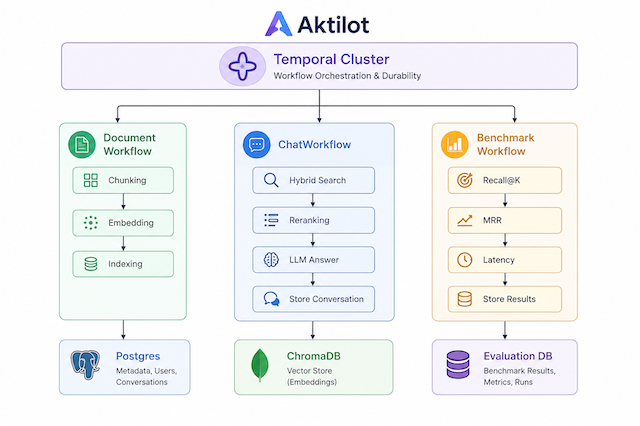
Document ingestion and chat both run as workflows on a Temporal cluster. Every activity is individually retryable and checkpointed — a failed LLM call retries alone, without re-running earlier steps or wasting API credits.
- DocumentWorkflowchunks, embeds, and indexes uploaded files into ChromaDB
- ChatWorkflowhybrid retrieval, LLM generation, conversation persistence
- BenchmarkWorkflowevaluates retrieval quality with Recall@K, MRR, and latency (coming soon)
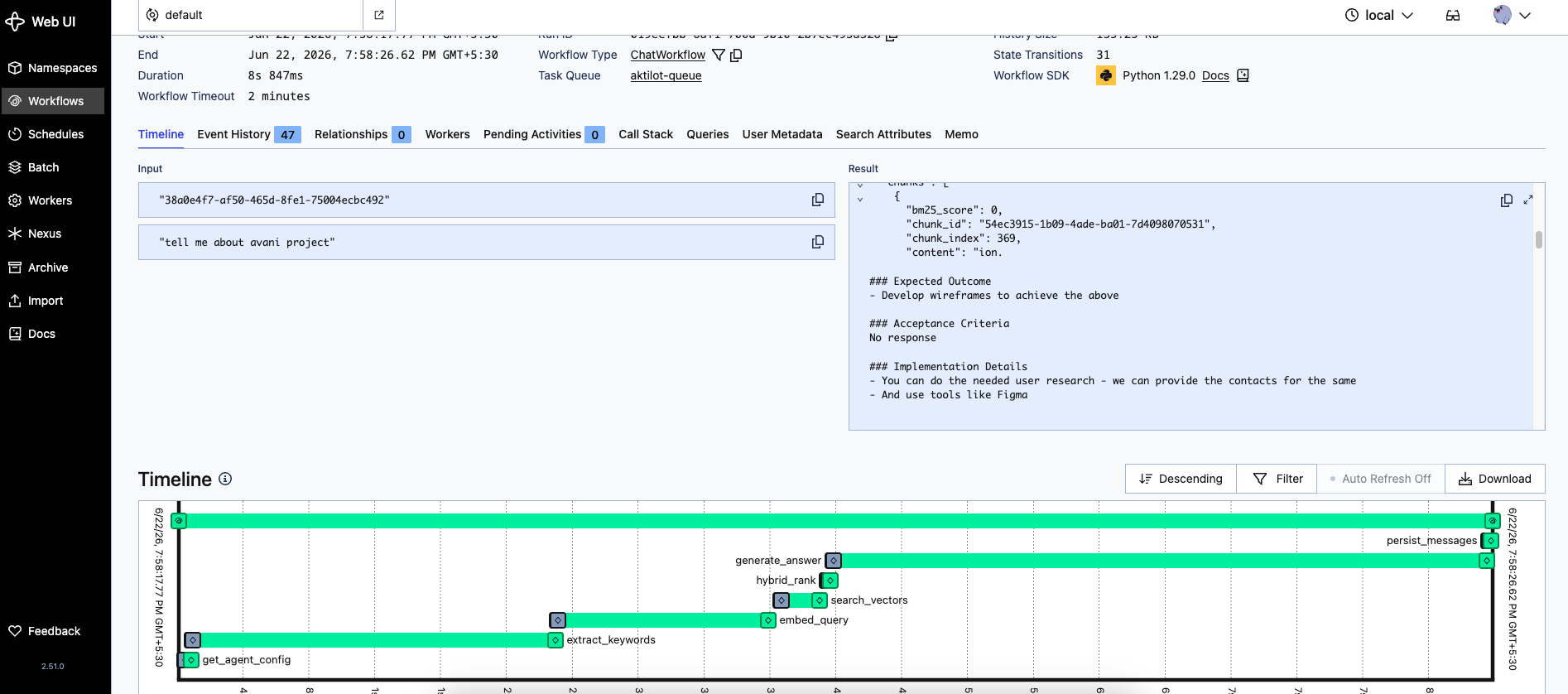
Nothing hides behind a spinner
Every ingestion and chat request is a Temporal workflow you can inspect step by step — retries, timing, and failures included.
Running in minutes
You need Docker and an LLM provider. Pick one and go.
git clone https://github.com/vikas0686/Aktilot.gitcd Aktilot cp .env.example .env# set OPENAI_API_KEY=sk-... docker compose up --buildWho's behind this
Built by engineers who've paid the price of complexity

Vikas Pandey
Principal Engineer
Vikas is a software engineer and payments architect with 17+ years building infrastructure that moves money reliably at scale — UPI, card processing, and distributed systems that can't afford to be wrong. Aktilot applies that same discipline to RAG: durable, checkpointed workflows instead of fire-and-forget scripts, and full observability instead of a black box.

Kush Saraiya
Principal Consultant
Kush brings 17+ years of engineering judgement to Aktilot — from distributed systems and platform modernisation to the kind of architectural decisions that look simple on a whiteboard and expensive in production. His focus on observability, durable workflows, and systems that don't hide their failures shapes how Aktilot is designed from the ground up.